Roofing
Roofing
Shingle, metal, clay tile and commercial roofing, plus the insurance claim if a storm is why you're calling.
Chapter 01
Tear-off and what the deck tells you
Every roof starts the same way once the old shingles come off: a look at the deck underneath. Most of the time it's sound, and the job is exactly what the estimate said it would be. Sometimes it isn't. Plywood that's gone soft around a vent stack, sheathing that's delaminated from years of trapped moisture, or a spot where a prior repair was nailed over rot instead of through it, all of that only shows up once the shingles are gone.
That's why the deck gets checked board by board before a single new shingle goes down, not glanced at from a ladder. A rotted section gets cut out and replaced before the underlayment goes on, because nailing a new roof to a bad deck just buries the problem for a few years instead of fixing it. It's the part of a reroof a homeowner never sees, and it's the part that decides whether the roof actually lasts.
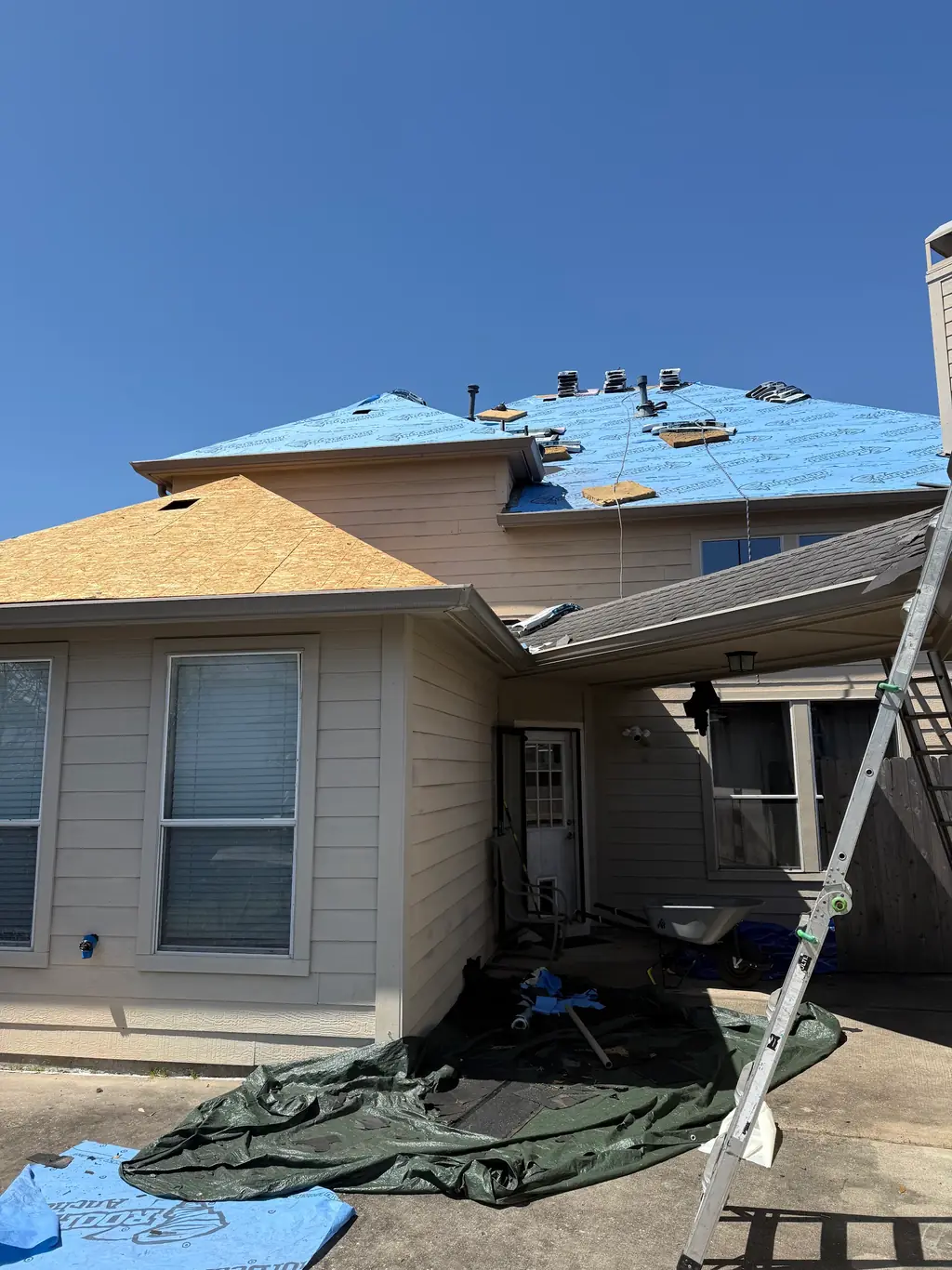
An active reroof with blue synthetic underlayment down and the old shingles torn off.
Synthetic underlayment and wind uplift on the Gulf Coast
This close to the coast, the underlayment matters as much as the shingle on top of it. Synthetic underlayment goes down over the deck before anything else, and it's what keeps water out if a shingle ever lifts or cracks in a storm. It's also tougher underfoot during the install, which matters on a job that can run a full day or more with a crew walking the same sections repeatedly.
Wind uplift is the other half of it. A roof that looks fine in a light breeze can shed shingles fast once gusts get up into the range a Gulf storm regularly produces, and the fastening pattern at the edges and ridge is what resists that, not the shingle brand. Getting the nail placement and the starter course right along every eave and rake is the difference between a roof that sheds a few shingles and one that stays put.
Chapter 03
Shingle, metal, or clay tile, matched to this coast
Asphalt shingle is still the most common call, and for most homes in League City it's the right one: proven in this climate, a wide range of colors and profiles, and the fastest to install. Shingle projects typically run $7,000 to $30,000 depending on the size and pitch of the roof and how much of the deck needs replacing underneath.
Metal roofing costs more up front, usually $15,000 to $75,000, but it sheds a hurricane-force gust better than shingle and holds up longer against the salt air near the water. Clay tile shows up on some of the older and higher-end homes in the area and has its own install requirements around weight and underlayment. Commercial roofing is its own category again, usually flat or low slope, and gets specified to the building rather than to a standard residential pitch. Which one makes sense depends on the roof, the budget, and how long the homeowner plans to be in the house.
Documenting the damage while the crew is already up there
A lot of the roofs Upper Hand replaces started with a hailstorm or a named storm off the Gulf, not a roof that simply wore out. When that's the case, the same visit that inspects the roof also documents it: photos of every damaged shingle, every dented vent cap, every bruise on the flashing, before anyone starts pulling material off.
That documentation is what an adjuster needs to approve a claim, and having it gathered by the crew that's already on the roof, rather than reconstructed later from memory, is what keeps a claim from getting shorted and speeds up how fast the approval comes back.
Upper Hand Roofing & Construction has been reroofing homes and buildings across League City and the surrounding counties since 2014. Call (832) 632-1160.
If a storm is the reason you're calling, read how Upper Hand handles the claim itself on the insurance claims page, or get in touch to have someone come look at the roof in person.