Flooring
Flooring
LVP, tile, hardwood, laminate and stained concrete, put down over a subfloor that's actually been checked. That's the part most flooring jobs skip.
Chapter 01
The right floor for a humid Gulf Coast house
Every flooring material handles moisture and heat differently, and on the Gulf Coast that difference matters more than it does most places. Solid hardwood expands and contracts with humidity swings, and a slab house near the coast puts more of that swing into the floor than an inland home ever sees. Engineered hardwood handles it better because the plywood core is more dimensionally stable, but it still isn't the first choice for a bathroom or a mudroom.
Luxury vinyl plank is fully waterproof and shrugs off the humidity, which is why it's become the default in kitchens, entries and anywhere near a slab that could still be holding ground moisture. Tile is the most water tolerant option of all and the only real choice inside a shower, but it's unforgiving underfoot and cold in a Gulf Coast winter. Laminate looks close to hardwood at a lower cost, but it's the least water tolerant of the group and needs the driest room in the house. Stained concrete skips the subfloor question entirely by finishing the slab itself, which is a real option in a garage conversion, a sunroom or anywhere a durable, low maintenance floor matters more than warmth underfoot.
We'll walk the rooms with you, talk about how each one actually gets used and where water and humidity are the real risk, and land on the material that fits the room instead of picking one finish for the whole house.
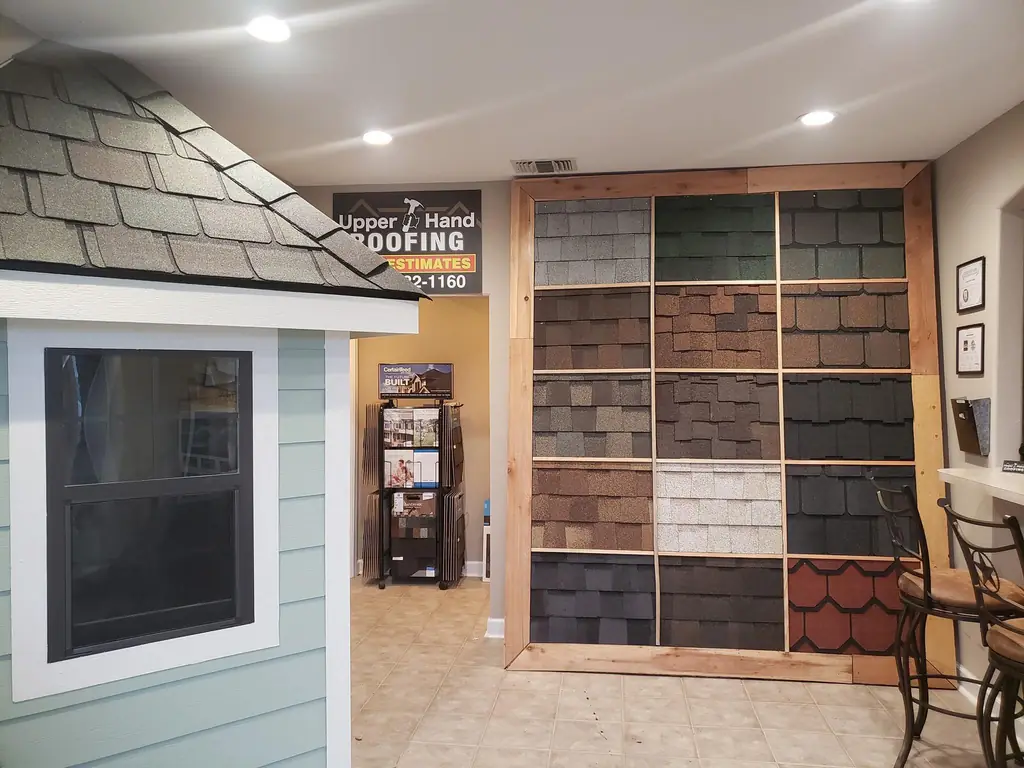
The Upper Hand showroom in League City, with a cedar framed wall of real material samples
Subfloor flatness and moisture testing before anything gets laid
A new floor is only as good as what it's sitting on. Before any material goes down we check the subfloor for flatness, because a low spot or a high spot that would have been invisible under carpet turns into a visible dip or a clicking joint under LVP, laminate or a floating hardwood floor. Most manufacturers spec a flatness tolerance of around 3/16 inch over a 10 foot span, and a subfloor outside that gets self leveling compound or patch and sand before we move forward, not after the floor is already installed and someone's asking why it's uneven.
On slab, we run a moisture test before flooring goes down, not after. A slab that reads wet, whether from ground moisture coming up through the concrete or a slow leak nobody's found yet, will ruin an adhesive bond, cup a hardwood plank or grow mold under a vapor sensitive material within months. Catching that before installation is a lot cheaper than pulling up a new floor to find out why it failed. On an older slab, or a room that's had water intrusion before, this step isn't optional.
Chapter 03
Transitions, trim and the finish detail
The difference between a floor that looks installed and one that looks finished is almost always in the transitions. Where flooring meets tile, where a hallway meets a bedroom, where a floating floor meets a fixed one, that joint needs a transition strip sized and set correctly, not a gap covered with a bead of caulk. Doorway thresholds, stair nosing and expansion gaps around the perimeter of a room all matter for the same reason: flooring materials move with temperature and humidity, and a floor installed without room to move will eventually buckle or gap at the edges.
Baseboard and shoe molding get reset or replaced to sit tight against the new floor line, scribed where walls aren't perfectly straight rather than caulked to hide a gap. It's the last hour of a flooring job and the easiest to rush, but it's also the part a homeowner looks at every single day.
Upper Hand Roofing & Construction, full service residential and commercial general contractor. Call (832) 632-1160.