Gutters
Gutters
Gutters sized for how hard it actually rains here, and a real plan for where the water goes once it leaves the downspout.
Chapter 01
Sizing and fall for what a Gulf Coast downpour actually drops
A gutter that works fine in a light rain can overflow the second a real Gulf downpour shows up, because the volume of water dropping per minute here is a different problem than a standard residential gutter spec assumes. Sizing the gutter and the downspouts to the actual roof area, not just running a standard profile around the whole house, is what keeps water in the gutter instead of sheeting off the edge during the storms that matter.
Fall matters just as much as size. Every run has to pitch consistently toward the downspout, not just look level from the ground, or water sits in the low spots and finds the first gap in a seam or a hanger to leak through instead of draining where it's supposed to.
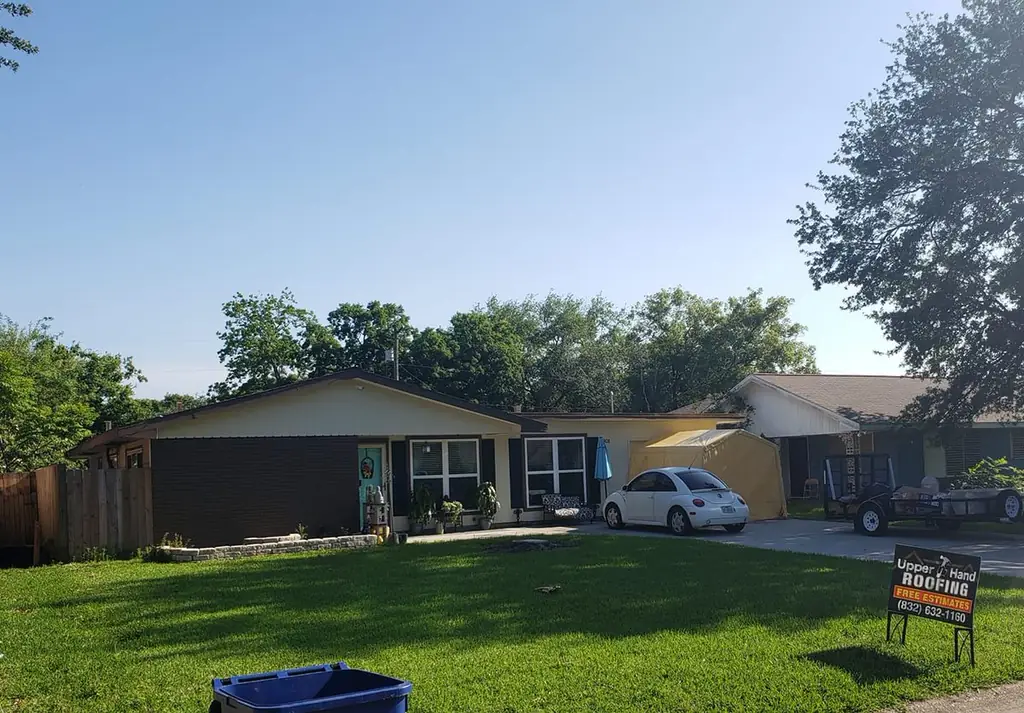
A residential job site with an Upper Hand yard sign and a work canopy set up in the driveway.
What's usually found behind old gutters
Pulling down a set of gutters that have been up for fifteen or twenty years almost always turns up something behind them: fascia board that's gone soft where water has been running behind the gutter instead of into it, drip edge that's rusted through or was never installed at all, or nail holes in the fascia from hangers that gave up years ago.
None of that gets covered back up with a new gutter hung over it. Rotted fascia gets cut out and replaced, drip edge gets corrected so the roof edge actually sheds into the gutter instead of behind it, and the fascia gets solid enough to hold new hangers before anything new goes up.
Chapter 03
Where the water actually goes after it leaves the downspout
A gutter system that dumps water two feet from the foundation hasn't really solved anything, it's just moved the problem from the roof to the yard. Downspout extensions that carry water well away from the slab are the minimum, and on a lot of League City lots where the ground is flat and doesn't drain on its own, that's not enough either.
When water is pooling near the house no matter how far the extensions run, or a low spot in the yard stays wet for days after a storm, a French drain is usually the real fix: a buried perforated pipe that carries water underground to a spot where it can actually get away from the house. It costs more than an extension, but it solves the problem an extension is just working around.
Doing gutters at the same time as a roof or siding job
If a roof or a siding job is already scheduled, doing the gutters at the same time makes sense on more than one level. The ladders and the crew are already at the house, new fascia and drip edge line up cleanly with new gutters instead of being matched to whatever was there before, and a fresh roof or wall isn't put at risk a year later by an old gutter that finally lets go.
Upper Hand Roofing & Construction has been installing and repairing gutters across League City and the surrounding counties since 2014. Call (832) 632-1160.
Planning a reroof or a re-side too? See roofing and siding, or get in touch to have someone look at what's going on with the current gutters.